

With the Autumn Budget a few days away, HM Treasury is working on a rumoured ‘smorgasbord’ approach to tax measures in the Budget as a result of a significant U-turn by the Labour government on income tax rises. The burden on Rachel Reeves’ Treasury to deliver a Budget that upsets neither the markets, the electorate or the Parliamentary Labour Party cannot be understated.
Amidst the high stakes of the Budget, the Treasury is also facing internal pressures arising from requirements to reduce running costs and cut staff. Government departments across Whitehall have significant targets to reduce costs, with at least 8,500 civil servants expected to leave under the exit schemes planned up to 2027, with a further 3,500 to go by 2030. Whilst the Treasury is by no means the most bloated department and is only expected to need to cut 350 jobs by 2029 to meet the spending review settlement, 350 jobs equates to around a 15% admin budget cut for HMT, which is not insignificant.
As a result, the challenge for the Treasury will be deciding which policy areas they want to prioritise and, in some cases, continue to ‘co-own’ with other departments, and which they will have to relinquish some control over. There could be a question mark over sustainable finance, for example. This is a policy area that HMT shares with DESNZ; with two departments across Whitehall currently fronting their own teams on this issue, there will likely be suggestions that policy advisers tied to this area could be cut to avoid duplication. However, HMT will be reluctant to give up oversight of sustainable finance in its entirety, not least because of its differing approach to DESNZ. Whilst this might be welcomed by some within Government who often see HMT as a blocker, the Treasury are unlikely to relish the idea of relinquishing authority.
To support in the exercise of cutting staff, the Treasury has run the ‘voluntary exit scheme’ where officials can put themselves forward for redundancy. It is understood that by January, all applicants to the voluntary exit scheme will have received offers regarding their exit package, which they can either accept or decline. In general terms (not including offers around pensions), applicants will receive one month’s pay for every year spent in the civil service, capped at approximately £95k. The exodus of Treasury officials from the civil service should then begin in Spring 2026.
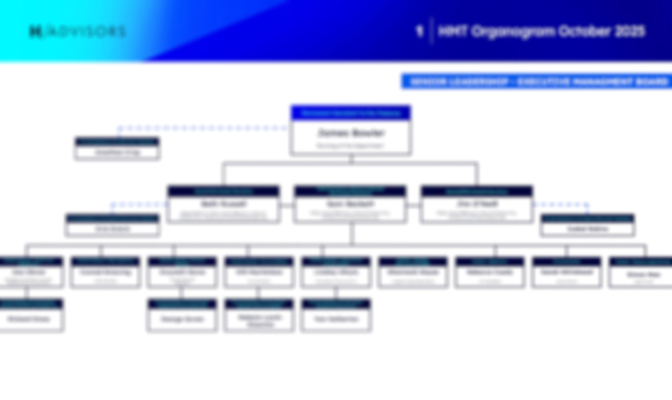
Until that time, H/Advisors Cicero has produced the latest iteration of our HMT organogram, which focuses on the Financial Services Group, but also includes the branch of HMT responsible for the Budget (Strategy, Planning and Budget), and the Financial Stability Group.
If you want to read a copy of our organogram, please get in touch with Harriet Hill Harrison at [email protected].
And as the Budget inches nearer, we’ll continue to update our Autumn Budget Speculation Tracker – click to download the latest version.